HubSpot
All-in-one CRM, marketing and sales platform with AI features to draft emails, score leads and automate follow-ups.
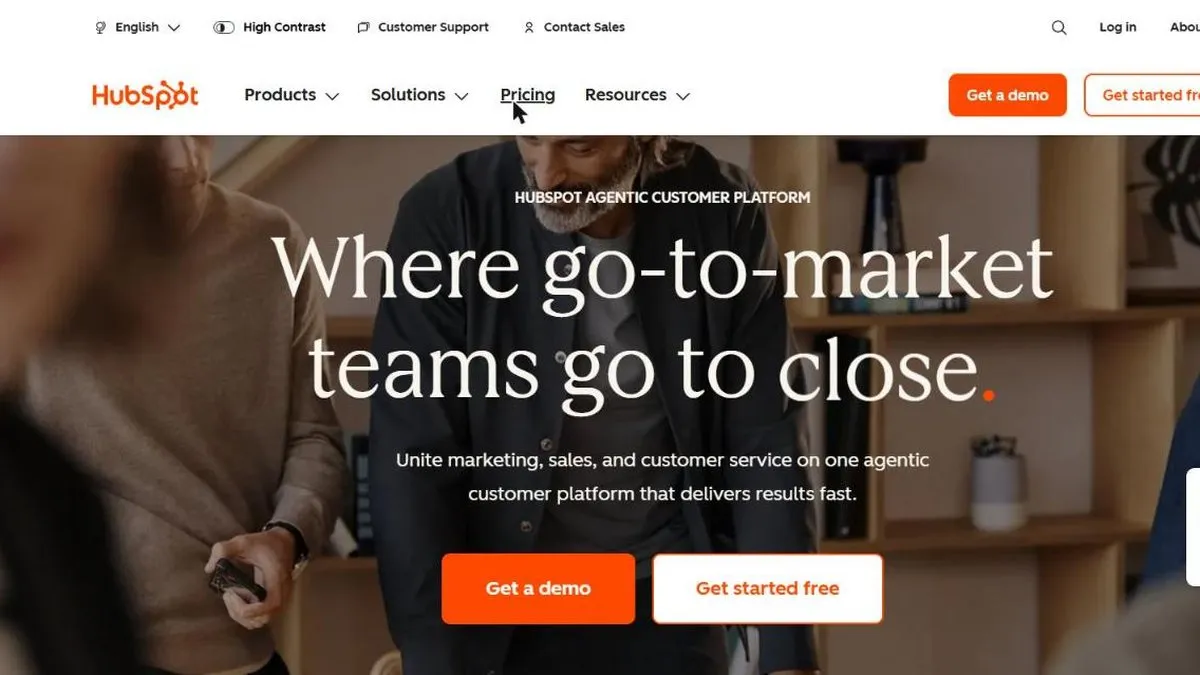
HubSpot is worth it if you already use (or plan to use) a CRM and want AI built in right there, instead of as a separate tool. It’s one of the most widely adopted CRM platforms among SMBs and marketing and sales teams, with an AI layer — Breeze — sitting directly on top of its existing modules: drafting emails and campaigns, automatic lead scoring, summarizing customer conversations, and agents that answer support questions on their own.
The advantage of having AI built into a CRM, rather than a standalone AI assistant, is that the context is already there: Breeze knows the contact’s history, the deal’s stage and the open support ticket, and can suggest the next step using that information instead of starting from zero in every conversation. That’s what sets it apart from a generic AI chat, which you’d have to copy-paste context into every time.
In practice
This shows up in concrete ways: the Content Agent drafting a first version of an email campaign from a short brief, the Customer Agent resolving repetitive support questions before escalating to a person, or the Data Agent flagging which contacts are most likely to close based on recent site and email activity. There’s also a Prospecting Agent that builds lists of new leads from the ideal customer profile already stored in the CRM, without a rep having to manually search LinkedIn or other sources. For a small sales team, that avoids building manual reports every week just to figure out which deals to focus on first.
Plans and pricing (2026)
- Free — a functional CRM for up to 2 users, with basic marketing, sales and support features, no cost and no card required.
- Starter (USD 7-20 per seat/mo, depending on the Hub) — includes a monthly allotment of Breeze credits (roughly 500) for basic AI and simple automations.
- Professional (from USD 800-890/mo, includes 3 seats; extra seats USD 45-100/mo) — considerably more AI credits (between 3,000 and 5,000 depending on the Hub), advanced automations and custom reporting; usually requires an upfront implementation fee of several thousand dollars.
- Enterprise (from USD 3,600/mo, includes 5 seats; extra seats USD 75-100/mo) — up to 10,000 Breeze credits, advanced permissions, custom objects and data governance, also with a separate onboarding fee.
One important nuance: HubSpot sells by “Hub” (Marketing, Sales, Service, Content, Operations), and each has its own pricing ladder, so the real cost depends on which combination your team needs. Breeze credits also aren’t unlimited on any paid plan — they’re consumed by usage, and if they run out before month-end, extra credits are bought for cents on the dollar each.
For this review we went through HubSpot’s published pricing structure and the Breeze credits included at each tier; we did not evaluate the full set of Hubs or Enterprise, which are beyond the scope of this review.
What to know before choosing
The most real limitation isn’t the entry price — the free plan is genuinely usable — but how it scales afterward: adding seats, contacts and extra Hubs can multiply the bill quickly, and the implementation fees on Professional and Enterprise are a separate cost that many price comparisons don’t show up front. It’s also not the simplest option if your team is small and doesn’t need AI-driven lead management — a lighter, cheaper CRM can cover that.
Worth it for sales and marketing teams that already think of a CRM as the center of their operation and want AI working on top of that data without extra integrations. Before signing up, it’s worth comparing the total cost against the alternative of a simpler CRM paired with a standalone AI tool: for a small team, that combination sometimes comes out cheaper than HubSpot’s native integration, even if it loses some shared context between modules. If all you need is sending a few emails or managing a handful of contacts, the free plan is probably enough without upgrading.
Pros
- Unifies CRM, marketing and sales on a single platform
- AI features (Breeze) are built into the workflow, not a separate add-on
- Has a genuinely usable free plan to get started, not just a limited trial
Cons
- Cost scales quickly as you add seats, contacts and extra Hubs, and Professional/Enterprise add implementation fees on top
- So many features can overwhelm a small team that only needs the basics